
Walks
Loose-leash training that survives the sidewalk
Teach walking near you with short reps, fair payoffs, and a distraction ladder, not a tug-of-war to the corner store.
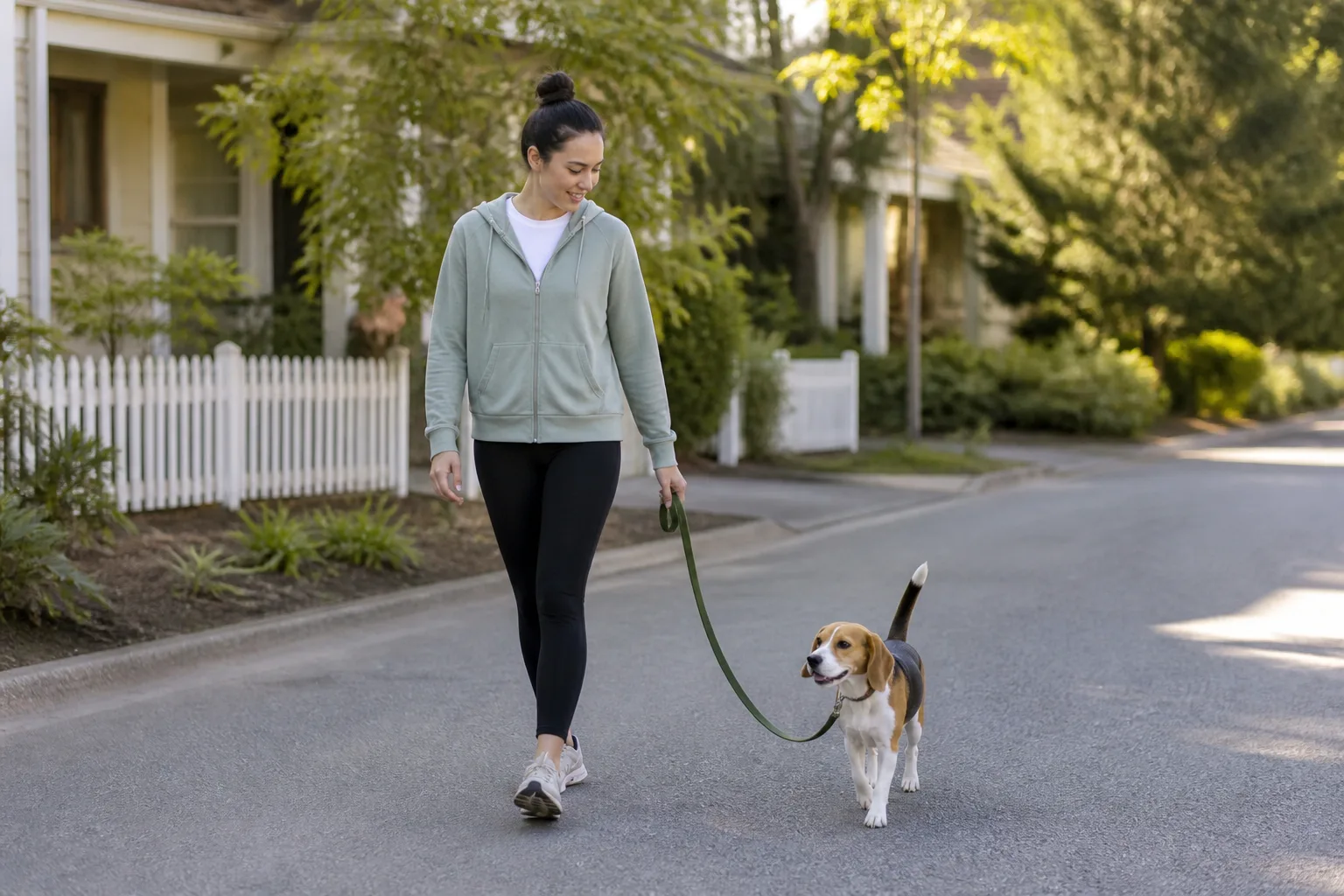
The second the front door opens, your dog becomes a sled dog. Smells pull. The leash goes tight. You brace. If pulling already works to reach the good stuff, dogs will keep pulling until walking near you becomes the clearer path to good things.
This guide stays reward based and stepwise. DogPath’s loose-leash program follows the same ladder: easy wins first, then more realistic streets. It is a practical plan for the walk you actually take, not a demand for a perfect heel on day one.
The walk starts at the leash, not the sidewalk
Begin in a quiet hallway or yard where your dog can notice you. Use comfortable, properly fitted gear, a standard leash, and rewards you can deliver fast.
If your dog explodes at the door, practice calm leashing and a few indoor steps first. Equipment time is part of the skill.
A loose leash is a soft curve, not a taut line with you braced against it.
Pay walking near you, not only the stop
Mark and reward when your dog chooses a position beside or close to you. Frequent early payments teach that staying nearby is productive. Waiting until the leash is tight trains a different lesson.
When the line tightens, change direction cheerfully, then reward the moment your dog catches up and softens the leash. Pattern work beats arguing forward into every smell.
Short blocks, clear criteria, one variable at a time
Practice one stretch of clean steps rather than a full neighborhood loop while everything falls apart. Ten good meters can be a full session at the beginning.
Raise difficulty one notch at a time: slightly busier place, a little more duration, then mild distractions. DogPath’s day-by-day leash track is built around that ladder.
- Quiet indoor or yard lanes first
- Short outdoor stretches with high-value pay
- Mild distractions only after clean reps
- End before frustration stacks for either of you
Give sniffing a legal job
Dogs need to sniff. Build intentional sniff breaks on a cue or at known spots so exploration isn’t only earned by dragging you. Structured sniffing reduces conflict on the line.
Be clear which moments are “walk with me” and which are “go sniff.” Ambiguity creates zigzag pulling.
Gear helps; criteria teach
A front attachment harness or properly fitted gear can make practice more manageable for some teams. Gear is not a substitute for paying the position you want, and pain or fear shortcuts can damage trust.
Adolescent dogs, scent-driven dogs, and under-exercised dogs may need more reps and better outlets. A 14-day program organizes practice; it doesn’t promise a perfect heel on every city block. If lunging, aggression, or panic shows up on leash, reduce pressure and get qualified help.
Teach leash position before the full neighborhood walk
A dog can learn that staying near you pays long before they can manage an entire walk without pulling. Begin in a hallway, driveway, or quiet stretch with enough space to turn. Mark one or two steps beside you and deliver the reward at the seam of your trousers. Release to sniff regularly so proximity does not predict the end of everything interesting.
The goal is not a competition heel. Everyday loose-leash walking allows the dog to explore while keeping tension out of the line. Choose the side, leash length, and release cue your household can use consistently. Clear rules reduce the alternating pattern where pulling sometimes works and sometimes starts a conflict.
Treat pulling as information about difficulty
A tight leash tells you the environment, pace, distance, or reinforcement plan is currently too hard. Stop or change direction calmly, then pay the return to slack. Avoid jerks and repeated verbal corrections. If the dog cannot reconnect, create distance from the trigger or move to a quieter route instead of rehearsing a thirty-minute struggle.
Equipment can support safety but cannot teach the skill by itself. A properly fitted harness and suitable standard leash may make practice more comfortable. Check fit and condition regularly. Retractable leads can make tension the normal way to gain distance, so consider whether they match the specific lesson you are teaching.
Use sniffing as part of the reinforcement plan
For many dogs, access to a scent is more valuable than food outdoors. Ask for a brief moment of slack, mark it, and release the dog to investigate. This Premack-style arrangement turns the environment into a reward while preserving a clear walking rule. It also makes the outing more enriching than a continuous position exercise.
Separate training stretches from decompression stretches. Practice for a few houses, then use a release cue and let the dog sniff on a longer but still safe line where appropriate. Alternating these modes helps owners stay consistent and gives the dog a realistic way to meet species-typical needs.
Read the session
How to know the plan is working, or already too hard
Progress is not one perfect attempt. Look for a pattern across comparable short sessions: clearer responses, faster recovery, willing re-engagement, and less help from the setup. Body language matters alongside the visible behavior.
Signs the level is workable
- The leash returns to slack without conflict
- Your dog can eat, sniff, and reconnect on the route
- Reward placement brings the dog back beside you
- Training and released sniffing periods are clearly signaled
Signs to make it easier
- Tension returns immediately after every reward
- The dog cannot disengage from a trigger at the current distance
- The whole walk becomes one continuous correction loop
- Equipment fit or handling creates discomfort
Choose the next change
Shorten the training stretch and move farther from the strongest distraction. Build a few more loose leash steps, then release to sniff so the walk remains reinforcing and realistic.
Before the next session, prepare rewards, choose the starting location, and decide what will count as complete. Change distance, duration, or distraction one at a time. If the dog cannot eat, disengage, recover, or move comfortably, stop treating the moment as an ordinary training plateau.
Before you begin
A fair-session checklist for this training goal
The exercise matters, but the conditions around it often decide whether learning is possible. Use this five-part check before the first cue. It takes less time than repairing a session that began too hard.
Outcome
Name one visible behavior and a finish line for today. Avoid broad goals such as “be calm” or “listen better.” Another person should be able to watch and tell whether the criterion happened.
Environment
Choose the quietest practical version of the real scene. Check surfaces, space, exits, people, dogs, sounds, and movement. Create enough distance for your dog to eat, recover, and re-engage.
Reinforcement
Prepare rewards before the cue. Match their value to the competing environment and decide where delivery should happen so it supports the next repetition instead of pulling the dog out of position.
Management
Decide how you will prevent the unfinished behavior from being rehearsed between attempts. That may mean a gate, barrier, long line, quieter route, prepared chew, greater distance, or skipping the difficult situation today.
Stop condition
Finish when the written criterion is met, focus drops, or body language says the level is no longer comfortable. Stopping early protects clarity. You can repeat the same small step later without losing progress.
After the session: make one decision
If the behavior was repeatable and your dog stayed engaged, repeat once more or raise distance, duration, or distraction by a small amount next time. If it was inconsistent, improve setup or rewards before replacing the goal. If pain, panic, aggression, bite risk, sudden change, or prolonged distress appears, stop the ordinary training plan and involve the appropriate veterinarian or qualified professional.
From article to action
Turn this guide into a practice week
Keep the goal stable long enough to see a pattern. Three or four tiny sessions across a week reveal more than one long attempt in a difficult environment.
Find the baseline
Reward three to five loose leash steps in a quiet area, then release your dog to sniff.
Build one layer
Add a few steps at a time while keeping reward placement beside you and turns predictable.
Generalize carefully
Practice on a slightly busier route at a distance where your dog can still eat and reconnect.
What to record
- Longest loose leash stretch
- Trigger distance
- Useful reward
- Where the route became too hard
Change only one major variable at a time. If success drops, return to the last version your dog could perform with relaxed, engaged body language.