
Recall
Dog recall training for a come cue worth answering
Install recall as a jackpot channel: easy starts, generous pay, long-line proofing, before you gamble on true freedom.
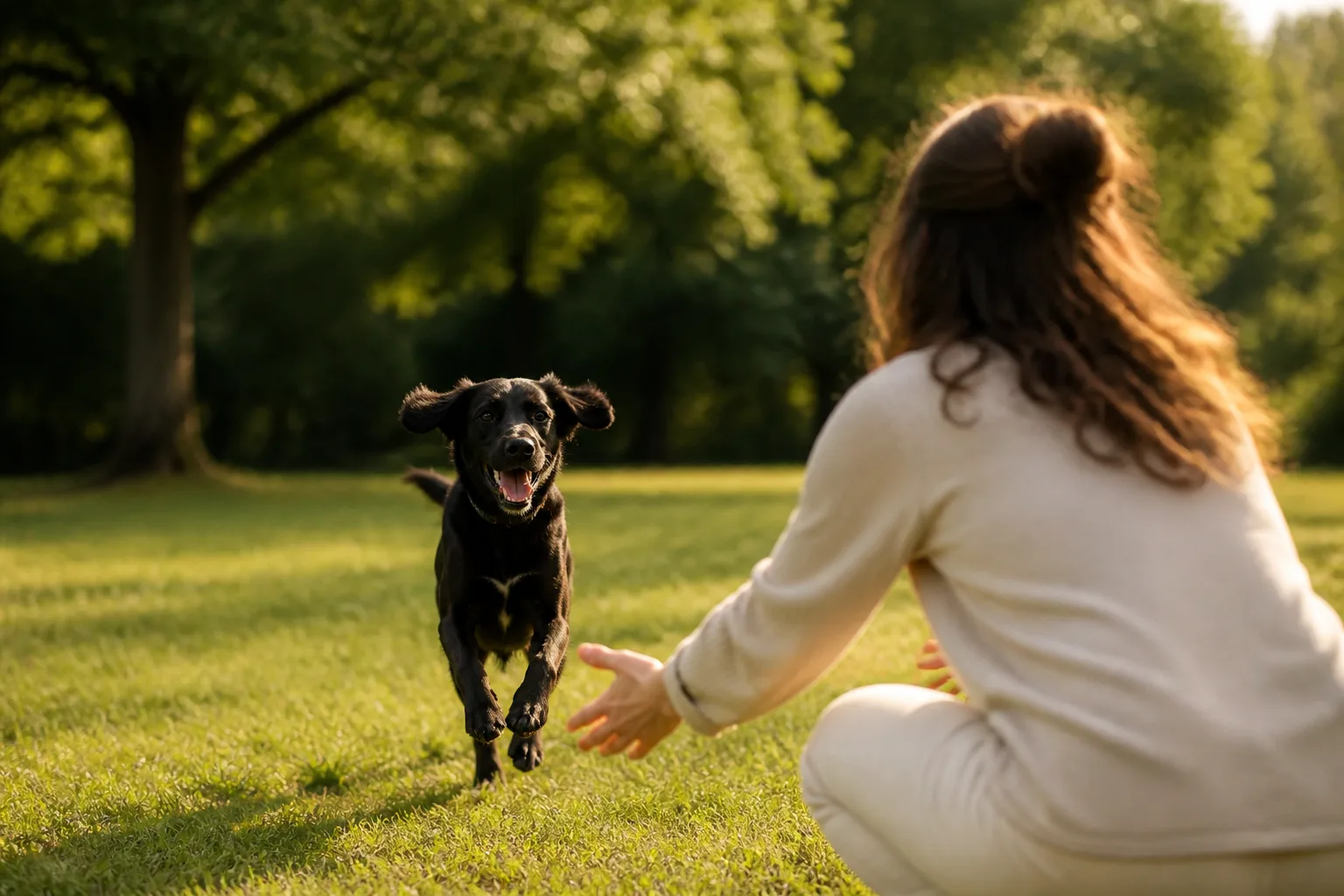
You call. The squirrel wins. Or worse, “come” has meant the fun ends, a bath begins, or nothing good happens. Dogs learn to shop the environment when arriving to you isn’t the better deal.
Train recall like a jackpot channel: clear cue, happy approach, excellent payment, then release back to freedom often enough that coming still feels like a win. DogPath’s recall program turns that logic into short daily steps for the call that matters.
Install the cue where success is easy
Start indoors or in a quiet fenced area. Say your come cue once in a bright tone, gently encourage if needed at the very beginning, then pay generously when your dog arrives.
Avoid repeating the cue like a chant. Multiple repeats teach that the first call is optional.
Protect the cue: don’t use “come” for something your dog hates until the habit is strong, and you can pair it with a major reward.
Pay like it matters
Early recalls should feel better than whatever your dog just left. Premium food, a favorite toy burst, a quick celebration, then often release to sniff or play again so arriving doesn’t always end the fun.
Cheap intermittent rewards too early create a gambler’s recall: sometimes they come, sometimes the squirrel wins.
Add distance on a long line before true freedom
A long line lets you practice real distance with a safety net. Call once, give your dog a chance to respond, and gently guide in if needed, without turning the line into a harsh snap.
Only remove that safety when success is boringly consistent in that location. Off-leash freedom is earned by proofing, not hope.
- Quiet rooms → yard → mild outdoor spaces
- Short distances before long ones
- Low distractions before dog parks or wildlife
- Long line until the pattern is reliable
Proof distractions on a ladder
Add one level at a time: a family member walking by, a dropped toy, a calm dog at a distance. If your dog fails, you asked too hard, reset easier and rebuild.
DogPath’s stronger-recall track climbs that ladder so you’re not inventing criteria under pressure. Some teams also keep a rare emergency jackpot cue, practice it carefully, and never turn recall into a chase game you can’t win.
Safety still comes first
No recall is 100% in every environment. Wildlife, dense urban risks, and high arousal can override training. Local leash laws and fences matter while learning.
DogPath structures practice. It can’t guarantee off-leash reliability or replace professional help for fear or aggression around other dogs or people.
Protect the cue from impossible tests
Every ignored recall changes the cue’s history. Say it once only when you have a reasonable chance of success, then help with movement, distance, or a long line. If the dog is already sprinting toward wildlife or deeply absorbed at the far edge of the field, manage safely instead of discovering how weak the cue is at maximum difficulty.
Use a long line attached to a suitable harness while generalizing outdoors. It prevents access to danger without turning the recall into a reel-in. Invite, move away, and reward the dog for choosing you. The line is backup management; the reinforcement history is what builds the response.
Make arriving better than being caught
Dogs quickly notice when coming always ends play, brings a bath, or leads to nail care. Practice recalls that pay generously and then release the dog back to sniff or play. Touch the collar softly, feed, and release so being within reach does not predict loss of freedom or uncomfortable handling.
Choose rewards that match the interruption you requested. Leaving another dog, a scent trail, or a garden chase deserves more than a dry biscuit the dog barely wants indoors. Use several treats, a favorite toy, a chase game with you, or permission to return to the activity when safe.
Build an emergency recall separately
An emergency cue should be rare, distinctive, and paired with an exceptional payoff every time. Condition it first at close range with no competing demand: say the cue, deliver a party of high-value rewards, and finish. Do not use it casually or when you cannot reinforce it properly.
The everyday cue still needs regular practice across rooms, gardens, and safe outdoor spaces. An emergency word is not a shortcut around that work. It is an additional safety behavior whose value depends on careful use. No recall training makes an unfenced hazardous area automatically safe; follow local rules and use physical management.
Read the session
How to know the plan is working, or already too hard
Progress is not one perfect attempt. Look for a pattern across comparable short sessions: clearer responses, faster recovery, willing re-engagement, and less help from the setup. Body language matters alongside the visible behavior.
Signs the level is workable
- The dog turns after one cue
- Arrival includes coming within comfortable reach
- Reward value matches the activity the dog left
- Some recalls release the dog back to safe exploration
Signs to make it easier
- The cue is repeated while the dog remains absorbed
- The long line has to pull the dog all the way in
- Coming consistently ends everything enjoyable
- Distance or distraction jumps beyond previous practice
Choose the next change
Return to the longest distance that produced a fast response and add only one mild distraction. Keep physical management in place until success is reliable across several safe environments.
Before the next session, prepare rewards, choose the starting location, and decide what will count as complete. Change distance, duration, or distraction one at a time. If the dog cannot eat, disengage, recover, or move comfortably, stop treating the moment as an ordinary training plateau.
Before you begin
A fair-session checklist for this training goal
The exercise matters, but the conditions around it often decide whether learning is possible. Use this five-part check before the first cue. It takes less time than repairing a session that began too hard.
Outcome
Name one visible behavior and a finish line for today. Avoid broad goals such as “be calm” or “listen better.” Another person should be able to watch and tell whether the criterion happened.
Environment
Choose the quietest practical version of the real scene. Check surfaces, space, exits, people, dogs, sounds, and movement. Create enough distance for your dog to eat, recover, and re-engage.
Reinforcement
Prepare rewards before the cue. Match their value to the competing environment and decide where delivery should happen so it supports the next repetition instead of pulling the dog out of position.
Management
Decide how you will prevent the unfinished behavior from being rehearsed between attempts. That may mean a gate, barrier, long line, quieter route, prepared chew, greater distance, or skipping the difficult situation today.
Stop condition
Finish when the written criterion is met, focus drops, or body language says the level is no longer comfortable. Stopping early protects clarity. You can repeat the same small step later without losing progress.
After the session: make one decision
If the behavior was repeatable and your dog stayed engaged, repeat once more or raise distance, duration, or distraction by a small amount next time. If it was inconsistent, improve setup or rewards before replacing the goal. If pain, panic, aggression, bite risk, sudden change, or prolonged distress appears, stop the ordinary training plan and involve the appropriate veterinarian or qualified professional.
From article to action
Turn this guide into a practice week
Keep the goal stable long enough to see a pattern. Three or four tiny sessions across a week reveal more than one long attempt in a difficult environment.
Find the baseline
Call once from a few steps away indoors, reward at your body, touch the collar, and release.
Build one layer
Add distance and mild distractions on a long line while paying every successful arrival well.
Generalize carefully
Practice in several safe places and include recalls that return your dog to the activity.
What to record
- Response after one cue
- Distraction present
- Reward value
- Distance that stayed reliable
Change only one major variable at a time. If success drops, return to the last version your dog could perform with relaxed, engaged body language.