
Manners
Door manners guests can live with
Swap jumping and hallway dashes for four paws on the floor greets, with setup, drills, and a plan for real visitors.
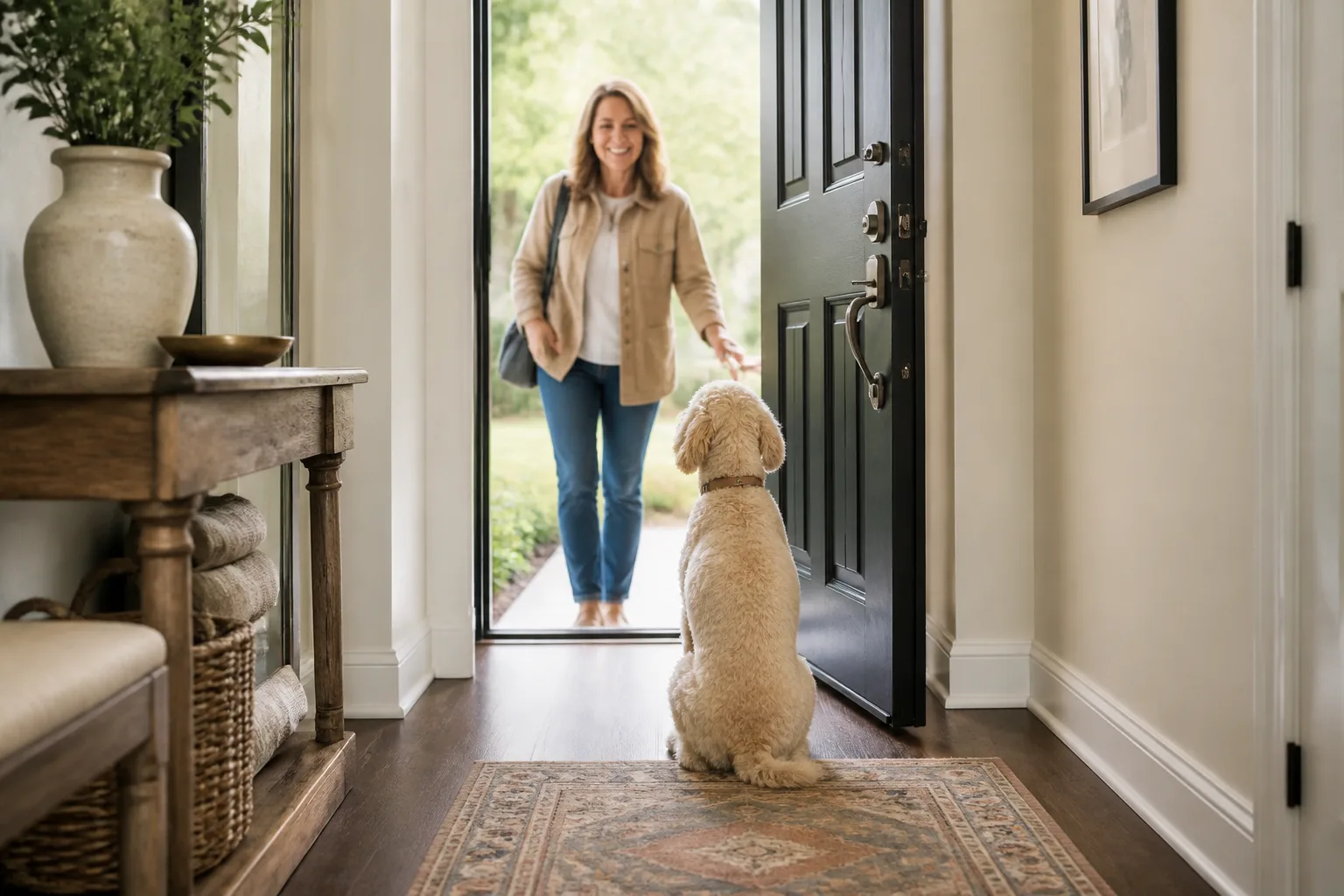
The doorbell rings. Your dog becomes a vertical greeting machine. Guests laugh, push away, or freeze, and every reaction still looks like social jackpot from the dog’s side of the leash.
Rushing the door has usually worked. Polite greetings need a new payoff for four paws on the floor. Keep practice reward based and staged. DogPath lessons and coach planning help you choose a manageable drill before real visitors arrive.
Manage the door before you train the door
Use a leash, baby gate, or closed room when guests arrive so your dog can’t rehearse full-speed jumping. Training can’t compete with daily unsupervised chaos at the threshold.
Ask guests not to pet or squeal while your dog is airborne. Attention is a reward, spend it on the behavior you want.
No paws on people means access to people. Jumping ends the greeting temporarily.
Teach an alternate greeting job
Common jobs: sit for hello, four paws on the floor, or go to a mat while the door opens. Pay heavily for the alternate. If jumping happens, calmly remove attention and reset to an easier version.
Practice without real guests first: doorbell sound, approach the door, reward the mat or sit, then release.
Build a doorbell and threshold drill
Ring a recorded doorbell at low intensity, cue the job, mark, and pay. Add a family member outside only after indoor reps look easy. Realism comes last.
Keep early sessions short. Door arousal rises fast and turns thinking brains into bouncing brains.
- Leash on for early door practice
- Reward four paws before petting starts
- Reset if jumping returns
- Raise guest excitement only after clean reps
Train the people as carefully as the dog
Household members should use the same cue and the same rule: polite feet get greetings. Mixed policies, “I let him jump, but guests shouldn’t”, keep the old habit alive.
Give guests a one-line script: wait for sit or mat, then pet the chest or shoulder calmly.
When the moment gets sticky, narrow the next step
If progress stalls, name the exact failure, bolt past knees, jump on guests, bark through the door, and choose a smaller drill. DogPath’s AI coach is useful for that kind of plan refinement; then you return to short practice.
Coach guidance is AI-supported planning, not certified behavior diagnosis. If your dog guards the doorway, escalates to snapping, or panics at visitors, get qualified help before ambitious greeting goals.
Decide what the dog should do instead of jumping
“Do not jump” leaves the dog without a clear route to the greeting. Choose four paws on the floor, a hand target, standing calmly, or going to a mat. A sit can work for some dogs, but very excited dogs may find it too difficult. The alternative must be easy enough to earn access to the person before arousal peaks.
Practice with household members first. The person approaches only while the chosen behavior continues, marks or feeds low, and steps away if paws rise. This makes the consequence predictable without shouting, kneeing, or holding the dog down. Attention arrives through the calm behavior; jumping no longer moves the greeting forward.
Rehearse the door routine when no guest is waiting
Real visitors add sound, movement, social pressure, and human impatience. Teach each piece separately: move to the mat, wait while the handle turns, stay behind a gate, or follow a food scatter away from the doorway. Use a family member as the practice visitor and stop after a few successful entries.
Management protects the plan on busy days. A gate, leash, closed room, or outdoor greeting can prevent jumping while the skill develops. Tell guests exactly how to help: ignore the dog briefly, avoid leaning over, and greet only when the chosen behavior is available. Consistent visitors are part of the reinforcement system.
Adjust the plan for fear, guarding, or bite risk
Not every difficult greeting is overexcitement. Retreating, hard staring, growling, snapping, freezing, or guarding access needs more distance and qualified assessment. Do not force contact or ask guests to hand-feed a fearful dog as a universal solution. The safest greeting may be no greeting at all.
Use barriers and a separate comfortable area while seeking a veterinarian or qualified behavior professional. DogPath can support foundation skills such as mat work and calm check-ins, but it cannot observe the full interaction or create an individualized safety plan for aggression or bite history.
Read the session
How to know the plan is working, or already too hard
Progress is not one perfect attempt. Look for a pattern across comparable short sessions: clearer responses, faster recovery, willing re-engagement, and less help from the setup. Body language matters alongside the visible behavior.
Signs the level is workable
- Four paws down or the mat keeps the greeting moving
- The dog can recover after a knock or door movement
- Guests understand one simple instruction
- Barriers prevent uncontrolled rehearsal
Signs to make it easier
- The dog is already jumping before the plan starts
- Visitors reward excitement inconsistently
- A sit is demanded when standing calmly is not yet possible
- Fear, freezing, growling, or bite risk is treated as excitement
Choose the next change
Rehearse with a prepared helper at a greater distance and reward before arousal peaks. Use separation rather than a greeting when body language or safety is uncertain.
Before the next session, prepare rewards, choose the starting location, and decide what will count as complete. Change distance, duration, or distraction one at a time. If the dog cannot eat, disengage, recover, or move comfortably, stop treating the moment as an ordinary training plateau.
Before you begin
A fair-session checklist for this training goal
The exercise matters, but the conditions around it often decide whether learning is possible. Use this five-part check before the first cue. It takes less time than repairing a session that began too hard.
Outcome
Name one visible behavior and a finish line for today. Avoid broad goals such as “be calm” or “listen better.” Another person should be able to watch and tell whether the criterion happened.
Environment
Choose the quietest practical version of the real scene. Check surfaces, space, exits, people, dogs, sounds, and movement. Create enough distance for your dog to eat, recover, and re-engage.
Reinforcement
Prepare rewards before the cue. Match their value to the competing environment and decide where delivery should happen so it supports the next repetition instead of pulling the dog out of position.
Management
Decide how you will prevent the unfinished behavior from being rehearsed between attempts. That may mean a gate, barrier, long line, quieter route, prepared chew, greater distance, or skipping the difficult situation today.
Stop condition
Finish when the written criterion is met, focus drops, or body language says the level is no longer comfortable. Stopping early protects clarity. You can repeat the same small step later without losing progress.
After the session: make one decision
If the behavior was repeatable and your dog stayed engaged, repeat once more or raise distance, duration, or distraction by a small amount next time. If it was inconsistent, improve setup or rewards before replacing the goal. If pain, panic, aggression, bite risk, sudden change, or prolonged distress appears, stop the ordinary training plan and involve the appropriate veterinarian or qualified professional.
From article to action
Turn this guide into a practice week
Keep the goal stable long enough to see a pattern. Three or four tiny sessions across a week reveal more than one long attempt in a difficult environment.
Find the baseline
Choose one greeting behavior and rehearse it with a familiar person at low excitement.
Build one layer
Add door sounds and approach in separate repetitions, rewarding before paws leave the floor.
Generalize carefully
Use one prepared helper as a visitor while a gate or leash prevents accidental rehearsal.
What to record
- Greeting behavior chosen
- Distance that stayed calm
- Guest instruction used
- First sign of over-arousal
Change only one major variable at a time. If success drops, return to the last version your dog could perform with relaxed, engaged body language.