
Everyday manners
How to stop a dog jumping up, without making greetings a battle
Teach four paws on the floor, control access to greetings, and give visitors a routine they can actually follow.
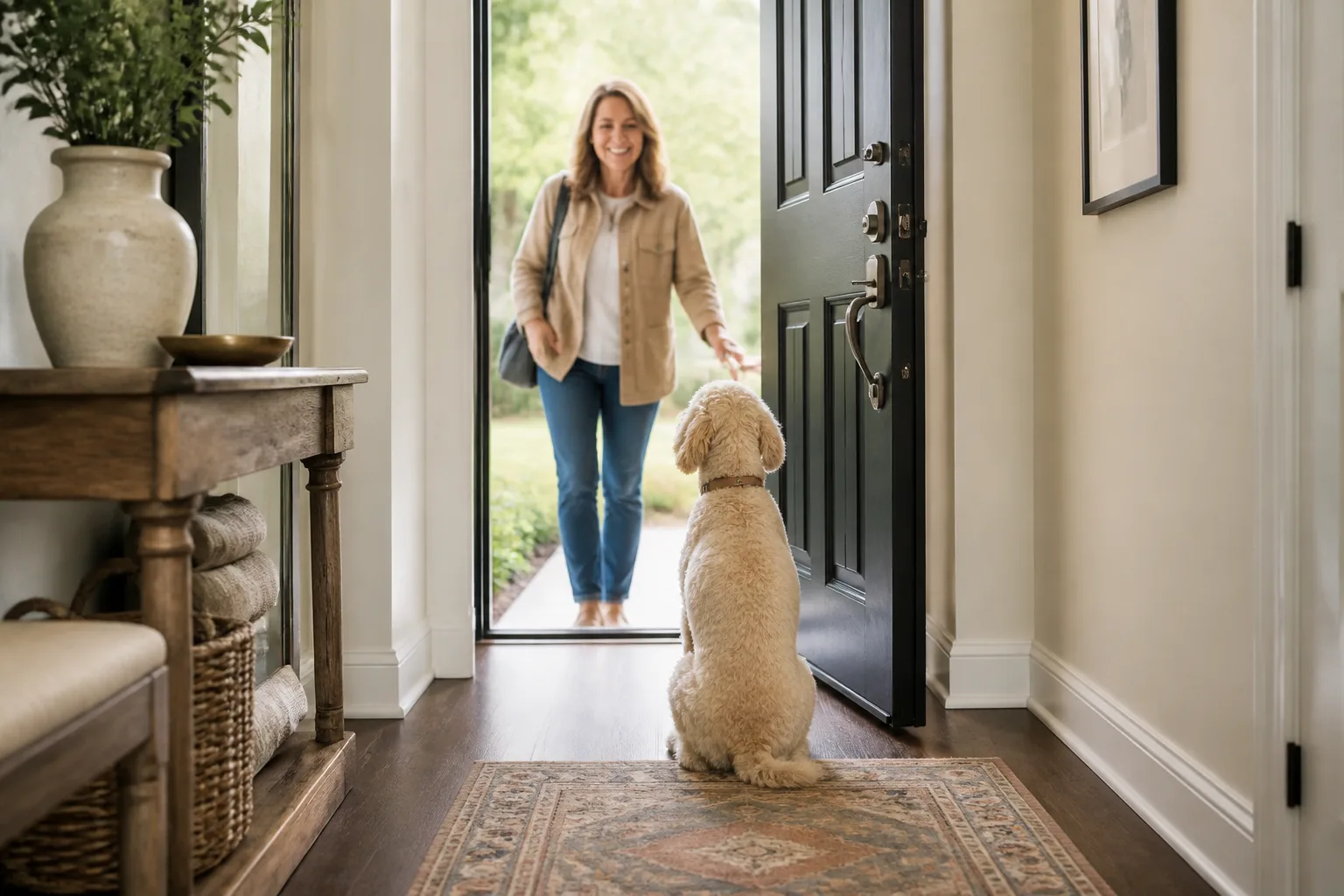
The door opens, your dog launches, and everyone starts improvising. One person says sit, another pushes the dog down, and the visitor rewards the whole performance with excited attention. Jumping survives because the greeting keeps paying it.
A better plan gives the dog a behavior that works, gives people simple instructions, and prevents full-speed rehearsal while the new habit grows. The goal is not a motionless dog. It is a greeting both dog and human can repeat safely and calmly.
Choose a greeting behavior before the person arrives
Four paws on the floor is the simplest universal criterion. Some dogs can also sit, touch a hand target, or move to a mat. Choose one option your dog can perform before peak excitement and make sure everyone in the household knows it.
Practice the behavior without a visitor first. Reward low, close to the dog’s position, and release after a few seconds. If sitting creates repeated bouncing, pay calm standing instead. The alternative must be easier than jumping at the current level.
The dog does not need to earn a greeting with perfection. They need a clear behavior that keeps access to the person moving forward.
Make approach and attention the everyday reward
Ask a familiar helper to approach while four paws stay down. Mark and feed, then let the helper come one step closer. If the dog jumps, the helper calmly turns or steps away. No shouting, kneeing, or wrestling is needed.
This teaches a direct rule: grounded behavior brings people closer; jumping pauses the greeting. Keep the first repetitions short enough that the dog can notice the pattern. An actual cuddle or hello can become part of the payoff once the approach stays calm.
Use management when the visitor is not a training partner
Delivery drivers, children, older relatives, and hurried guests should not be responsible for teaching the lesson. Use a gate, leash, separate room, outdoor greeting, or prepared food scatter so the dog cannot practice jumping in situations you cannot control.
Management does not delay training; it protects it. Every prevented jump is one less rewarded repetition. Train with prepared helpers at another time, then expand gradually to visitors who can follow the plan.
- Tell guests to keep hands and voices quiet at first
- Reward before excitement becomes a launch
- Keep greetings brief, then offer a settle break
- Use barriers for anyone who may be knocked over
Handle arrivals, homecomings, and street greetings separately
Jumping at the front door, when you return home, and when meeting someone on a walk may need three versions of the plan. Start where the dog is least excited. Homecomings can become calmer when you pause briefly, scatter food low, or greet after four paws settle.
For street greetings, ask before allowing contact and skip the interaction when the dog cannot stay connected. Not every person needs to say hello. Neutral observation and moving on are valuable social skills too.
Know when jumping is not the main concern
A dog who freezes, growls, guards the doorway, snaps, or shows fear needs distance and individualized assessment, not a standard greeting drill. Keep visitors separated safely and seek qualified behavior support.
Pain and mobility issues can also change how a dog greets or tolerates touch. Sudden changes deserve veterinary attention. DogPath can organize foundation practice, but it cannot assess risk from inside the app.
Why jumping keeps working
Jumping often produces exactly what the dog wanted: eye contact, hands, voices, movement, or access to a person. Even pushing the dog away can feel like an exciting social game. The solution is not to become harsher; it is to make a different, achievable behavior reliably open the greeting.
Management matters while the new history develops. Use a gate, leash, distance, or scattered food so the dog cannot rehearse full-speed jumping with every arrival. Then reward four paws on the floor before excitement peaks. A dog who is already airborne is working at a harder level than the one you need to teach first.
Match the alternative to the dog’s arousal
Some dogs can sit for greetings; others need the easier goal of simply standing with four paws down. A hand target can redirect movement, and a mat can create distance from the doorway. Choose one behavior the dog can still perform when a familiar person approaches, then build toward more exciting visitors.
Pay low and close to the floor so reward placement supports the behavior. Ask the person to approach, pause, or retreat according to what the dog does. Access to the greeting becomes part of the reinforcement. If the dog jumps, the person calmly steps away and the next repetition begins easier.
Read the session
How to know the plan is working, or already too hard
Progress is not one perfect attempt. Look for a pattern across comparable short sessions: clearer responses, faster recovery, willing re-engagement, and less help from the setup. Body language matters alongside the visible behavior.
Signs the level is workable
- Four paws stay down as a familiar person approaches
- The dog can accept food low without launching again
- The helper can pause or retreat consistently
- Management prevents surprise visitors from rewarding jumps
Signs to make it easier
- The greeting begins at full speed without a barrier
- People push, shout, or excite the dog further
- A sit is required after arousal has already peaked
- Fear or guarding signals are mistaken for friendly excitement
Choose the next change
Increase distance and reward the easiest grounded behavior before the helper moves closer. Keep real visitors behind a gate or leash until several prepared greetings stay predictable.
Before the next session, prepare rewards, choose the starting location, and decide what will count as complete. Change distance, duration, or distraction one at a time. If the dog cannot eat, disengage, recover, or move comfortably, stop treating the moment as an ordinary training plateau.
Before you begin
A fair-session checklist for this training goal
The exercise matters, but the conditions around it often decide whether learning is possible. Use this five-part check before the first cue. It takes less time than repairing a session that began too hard.
Outcome
Name one visible behavior and a finish line for today. Avoid broad goals such as “be calm” or “listen better.” Another person should be able to watch and tell whether the criterion happened.
Environment
Choose the quietest practical version of the real scene. Check surfaces, space, exits, people, dogs, sounds, and movement. Create enough distance for your dog to eat, recover, and re-engage.
Reinforcement
Prepare rewards before the cue. Match their value to the competing environment and decide where delivery should happen so it supports the next repetition instead of pulling the dog out of position.
Management
Decide how you will prevent the unfinished behavior from being rehearsed between attempts. That may mean a gate, barrier, long line, quieter route, prepared chew, greater distance, or skipping the difficult situation today.
Stop condition
Finish when the written criterion is met, focus drops, or body language says the level is no longer comfortable. Stopping early protects clarity. You can repeat the same small step later without losing progress.
After the session: make one decision
If the behavior was repeatable and your dog stayed engaged, repeat once more or raise distance, duration, or distraction by a small amount next time. If it was inconsistent, improve setup or rewards before replacing the goal. If pain, panic, aggression, bite risk, sudden change, or prolonged distress appears, stop the ordinary training plan and involve the appropriate veterinarian or qualified professional.
From article to action
Turn this guide into a practice week
Keep the goal stable long enough to see a pattern. Three or four tiny sessions across a week reveal more than one long attempt in a difficult environment.
Find the baseline
Reward four paws down while a familiar person stands still several steps away.
Build one layer
Let the person approach one step at a time while the dog’s chosen greeting behavior continues.
Generalize carefully
Practice with one prepared visitor, using a leash or gate so jumping cannot pay accidentally.
What to record
- Alternative behavior
- Approach distance
- Reward placement
- Point where excitement rose
Change only one major variable at a time. If success drops, return to the last version your dog could perform with relaxed, engaged body language.