
Leash walking
Dog Pulls Toward Other Dogs? A Free Training Plan
Create enough distance to think, reward voluntary check-ins, and change one part of the encounter at a time.
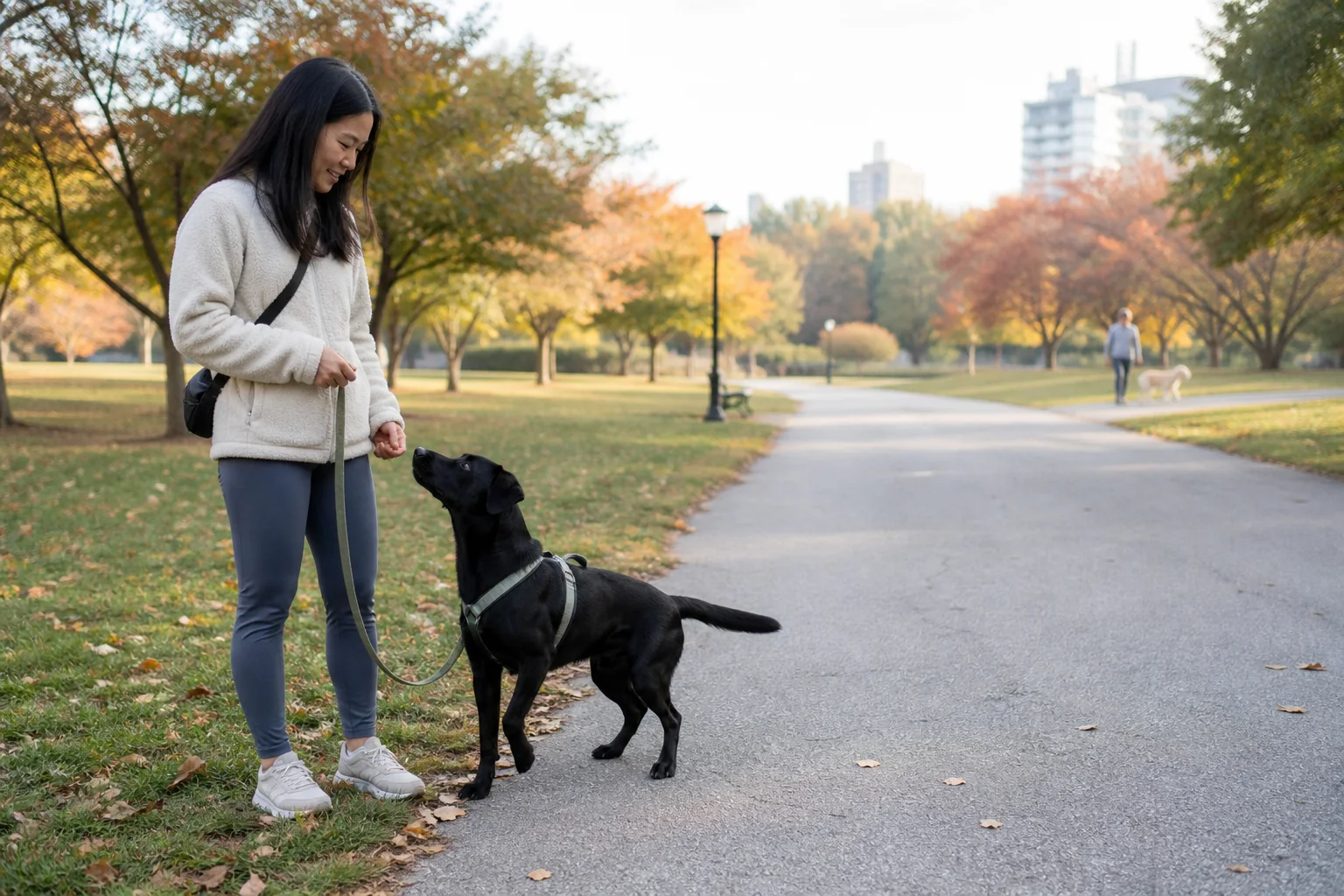
Your dog walks comfortably until another dog appears. Then the body leans forward, the leash tightens, and the quiet walk turns into a tow. When a dog pulls toward other dogs, the useful first question is not “How do I stop this immediately?” It is “At what distance can my dog notice the other dog and still eat, turn, or move with me?” That workable distance is where training begins.
Pulling can come from friendly excitement, frustration about not greeting, uncertainty, fear, or a mixture that changes with the other dog and the setting. A blog cannot diagnose the cause from the end of a leash. This plan therefore teaches observable skills: notice without rushing, check back voluntarily, follow a gentle turn, and recover after the dog has passed. It does not require leash jerks, intimidation, or forcing a close encounter.
DogPath helps you run the plan as short, repeatable sessions. Choose one visible behavior, prepare rewards before the walk, practise below your dog’s limit, change distance, duration, or distraction one at a time, and record what happened. The app is free to download on iPhone, iPad, and Android; some features or usage levels may require an in-app purchase. The goal is not perfect obedience beside every dog. It is a safer, clearer pattern you can repeat.
Before training when your dog pulls toward other dogs
Start with equipment that lets you guide without causing pain. A comfortable, well-fitted harness and an ordinary fixed-length leash give useful control while preserving a visible curve in the line. Check the fit before leaving: straps should not rub behind the front legs, restrict the shoulders, or slide around the body. Retractable leashes make distance and tension harder to predict during planned repetitions.
Prepare small, high-value food your dog can swallow quickly. The reward must compete with the environment without turning the session into frantic grabbing. Bring more than you think you need, choose a route with escape space, and avoid the narrowest popular path for the first practices. Training is easier when you can cross the road, step behind a parked car, or turn into a driveway before the leash tightens.
Rehearse an easy hand target and cheerful turn indoors before you need them outside.
A successful setup includes somewhere to go. If the path offers no safe exit, choose another place to practise.
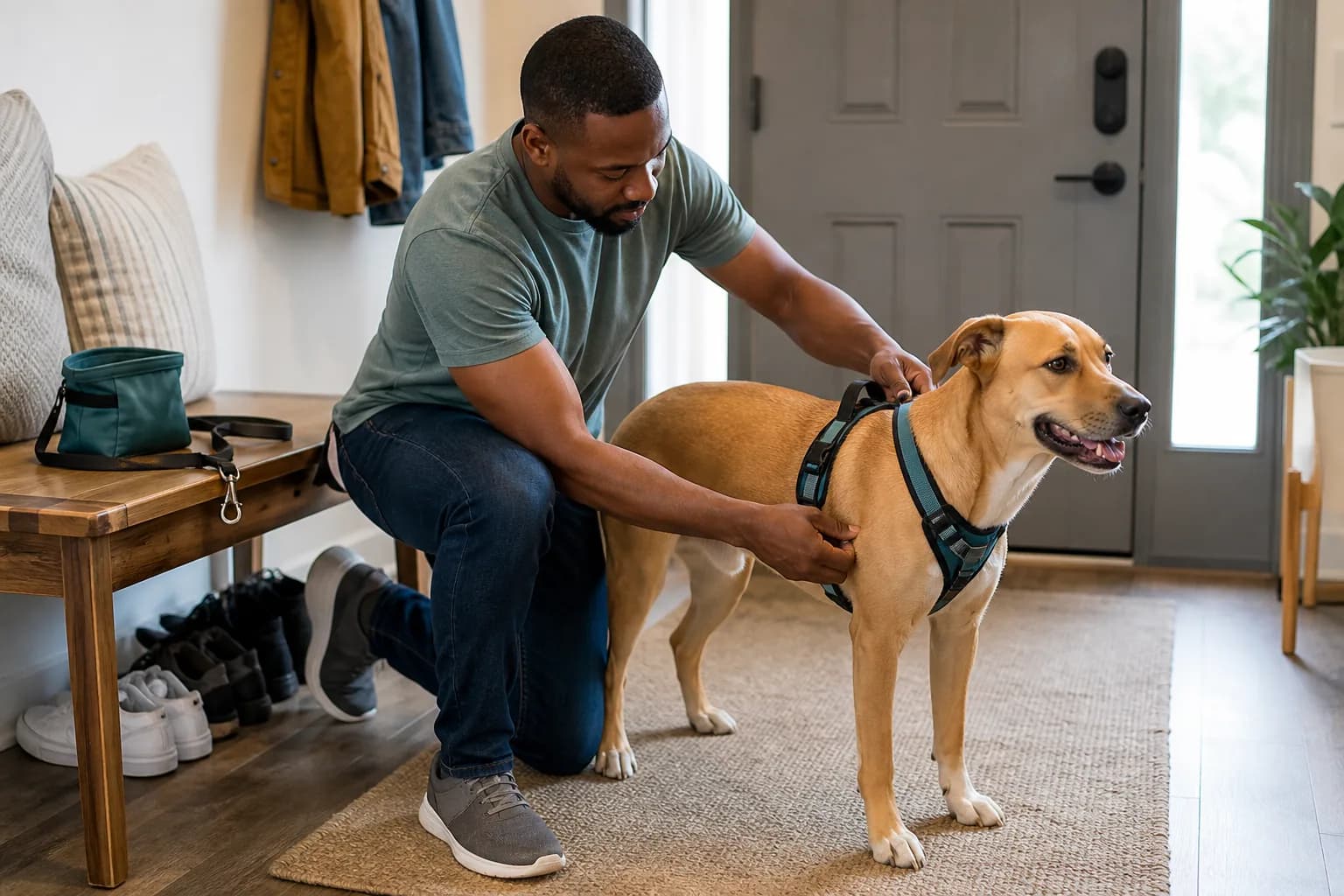
structure short dog-training sessions · teach a useful hand target
Find the distance where thinking is still possible
Working distance is not a fixed number of metres. It changes with the other dog’s speed, size, posture, and direction; with the width of the path; and with your dog’s sleep, discomfort, previous encounters, and arousal that day. Begin farther away than seems necessary. You can always make a later repetition slightly closer, but you cannot undo a frightening or explosive close pass.
Watch the whole body. A dog below threshold may notice the other dog, pause, sniff, accept food, blink, turn the head, or shift weight back toward you. A dog approaching the limit may close the mouth, lean forward, freeze, stare, raise the tail, stop eating, or take food harshly. These signals are information, not disobedience. Create more distance before the lunge or bark rather than waiting to prove the dog cannot cope.
Use the first few walks only to map this distance. In DogPath, record a simple estimate such as “across a two-lane street,” “half a football field,” or “behind three parked cars.” Note whether the other dog was moving toward, across, or away from you. Consistent descriptions are more useful than pretending your estimate is exact.
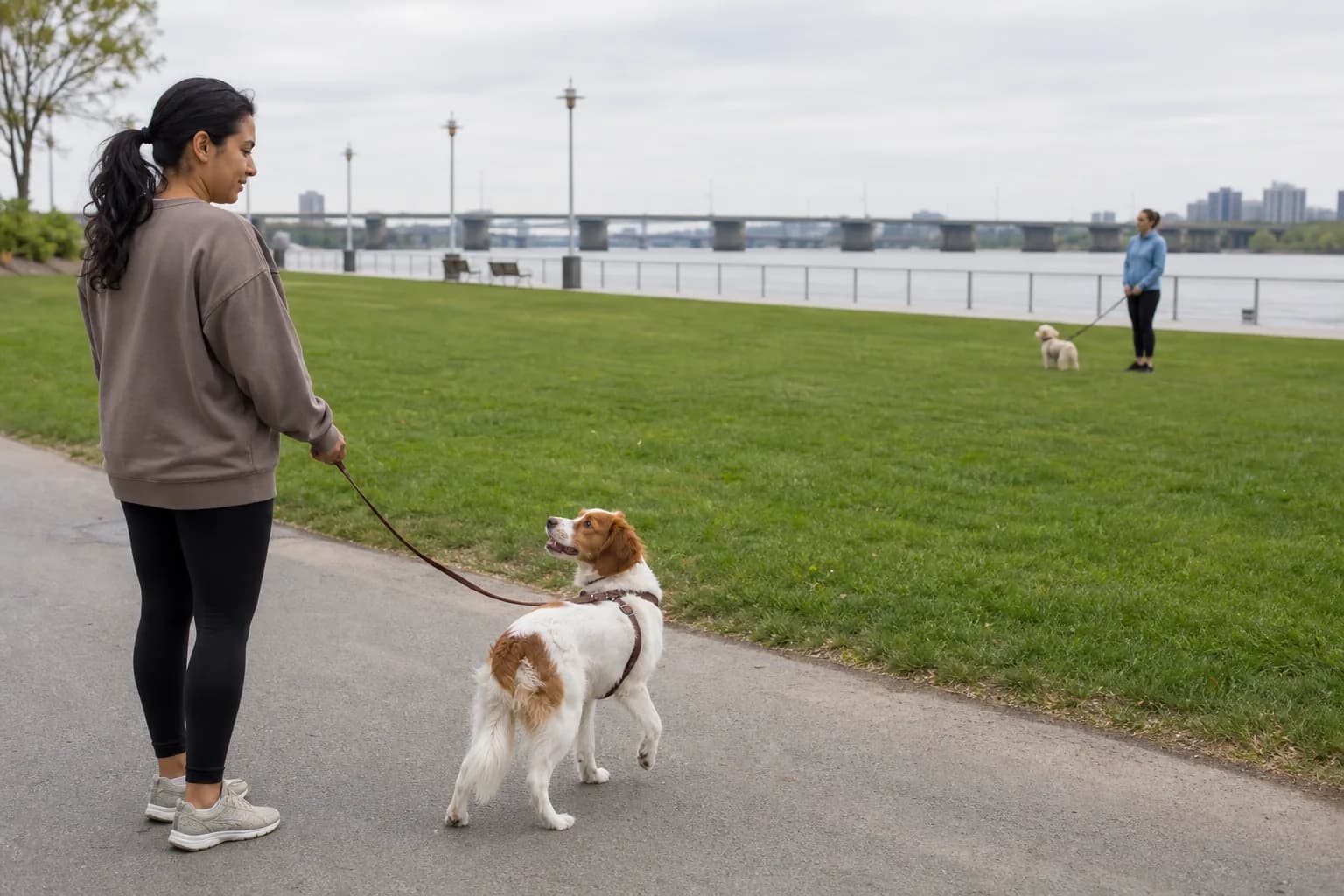
Reward the check-in instead of demanding eye contact
At a workable distance, let your dog see the other dog. The moment your dog softens, turns an ear, glances back, or shifts toward you, mark and place the reward close to your leg or slightly behind you. Reward placement matters: food delivered forward can accidentally pull the body toward the trigger, while food beside or behind you supports the next turn away.
Do not repeat the dog’s name until it becomes background noise. A voluntary check-in tells you the dog can disengage. If no check-in happens within a second or two, calmly increase distance, use the practised turn cue, or scatter a few treats away from the other dog if your dog can safely sniff and eat. The answer is a simpler picture, not a louder voice.
Keep the first set tiny. One dog seen at a generous distance, two or three rewarded choices, and a calm exit can be a complete session. Continuing until something goes wrong does not test progress; it teaches the hardest part of the encounter. DogPath’s clicker can mark the exact head turn, but a consistent marker word works too. Timing matters more than the tool.
- Notice the other dog without moving closer
- Mark the first soft turn or weight shift
- Deliver the reward beside or behind your leg
- Leave while your dog can still recover easily
Use curves, turns, and visual barriers early
Straight, head-on approaches are difficult for many dogs. Walk in a broad curve instead of marching directly past. Cross the street before the gap closes, step into an open driveway, or place a parked car, hedge, or wide tree between the dogs. Management is not cheating. It prevents another full-strength rehearsal and makes a learnable repetition possible.
Teach a U-turn when nothing is happening: say the cue once, turn your shoulders, move in a smooth arc, and reward as the dog catches up. Outside, use it while the leash is still loose. If you wait until the dog is braced at the end of the line, the cue has to compete with much stronger momentum and emotion. A turn should feel like an easy route change, not a punishment.
When you must pass, keep your body between your dog and the other pair when space allows, feed a short stream of rewards through the hardest seconds, and continue to a quiet recovery area. Do not stop for a forced sit if movement helps your dog. The visible goal is a loose enough body and leash to leave together, not a formal position.
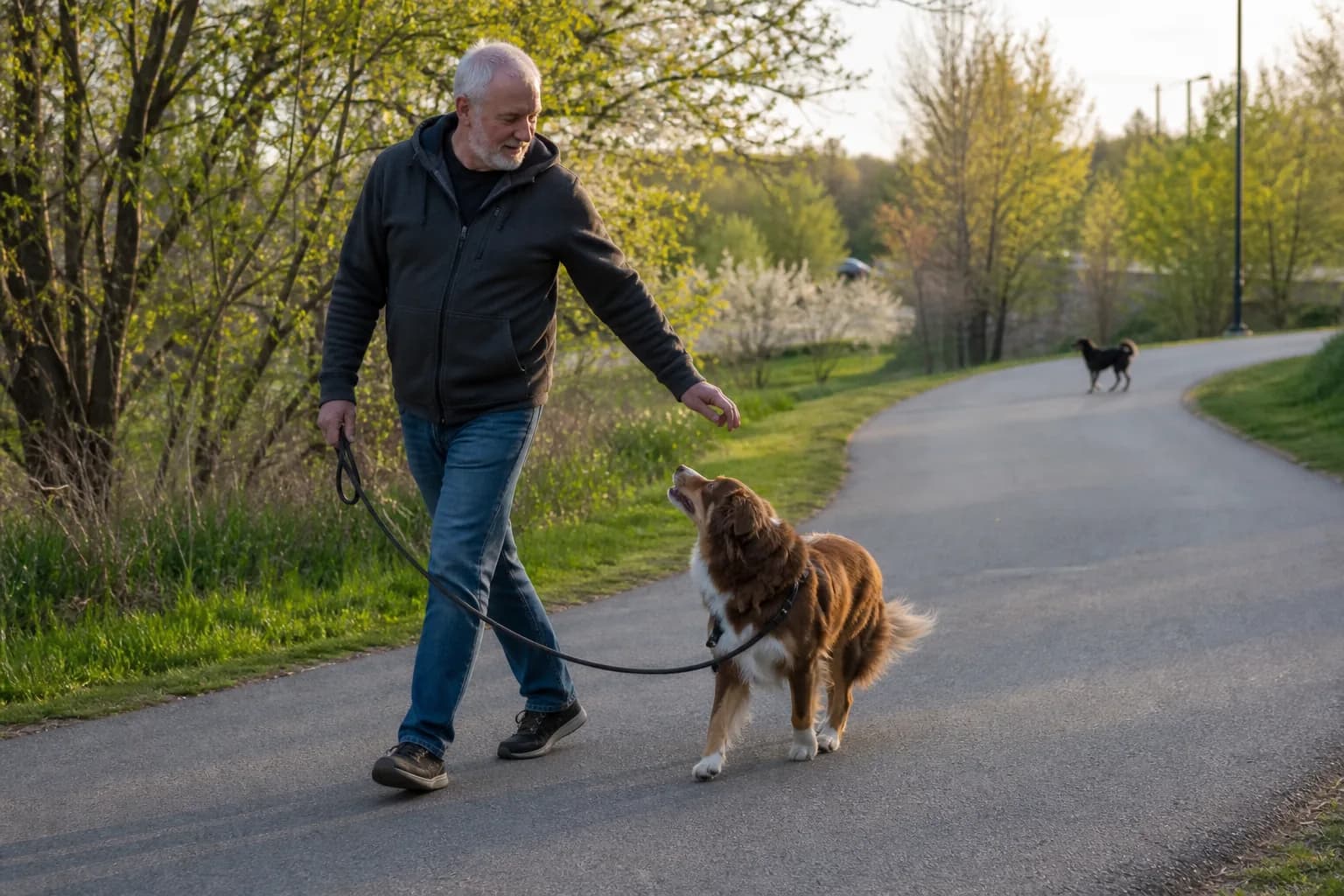
Change one part of the dog encounter at a time
A successful encounter contains several variables: distance, how long the other dog stays visible, whether it moves toward you, path width, number of dogs, and how quickly your dog can leave. Improving one variable does not mean all the others are ready. If yesterday’s calm dog stood fifty metres away, today is not the time to pass two running dogs on a narrow pavement.
Choose one planned change. You might keep the same distance while the other dog walks across the scene, reduce the gap by a few metres while both dogs stand still, or add one extra second before turning away. Then return to an easier repetition. This up-and-down pattern protects fluency and shows whether the change, rather than luck, produced the result.
DogPath is useful here because the session can have a visible pass criterion: “Notice one leashed dog across the road, check back twice, and leave on a loose leash.” When that is repeatable across several comparable walks, edit only one criterion. Avoid vague goals such as “be good around dogs,” which cannot tell you what to practise tomorrow.
Distance, duration, and distraction are separate challenges. Raise only one while the others stay easy.
Greetings are optional, not the reward for pulling
A friendly dog may pull because reaching another dog sometimes works. If a tight leash regularly leads to a greeting, pulling has a powerful real-world payoff. For a training period, make on-leash greetings rare and planned. A loose leash and the ability to turn away should come before permission to approach. Many dogs do better with parallel walking than with a stationary nose-to-nose meeting.
Do not use every calm check-in as a ticket to greet. Your dog needs to learn that seeing another dog can predict food, movement, sniffing, or simply continuing the walk. Otherwise the check-in becomes one more step in a chain that still ends with rushing forward. Ask the other handler before any approach, and accept “no” immediately.
If both dogs are suitable and the space is generous, walk in the same direction with distance between you. Reduce the gap only while both bodies remain loose. Keep the first interaction brief and call your dog away before tension builds. A dog who cannot disengage is not ready for the greeting, however friendly the intention looks.
PDSA reward-based advice for dogs that pull · build the loose-leash foundation
Record recovery, not just the closest pass
Owners often record the smallest distance and miss the more useful measure: recovery. After the other dog disappears, can your dog sniff, take food gently, respond to an easy cue, and resume a normal pace? A closer pass followed by five minutes of frantic scanning may be less successful than a distant sighting followed by immediate relaxation.
After the walk, log the location, approximate distance, direction of movement, your dog’s first body-language change, the response you rewarded, and recovery time. Keep the note short enough that you will actually make it. A pattern across five ordinary walks is more informative than a detailed story about one unusually good or bad encounter.
Review the notes before choosing the next session. If check-ins become quicker and recovery becomes shorter at the same distance, the plan is working even before you move closer. If eating, movement, or recovery deteriorates, restore more space and reduce the number of encounters. Progress is a wider zone of comfortable choices, not a race toward the narrowest gap.
Know when this free plan is not enough
Ordinary excitement and mild greeting frustration can improve with thoughtful distance and repeated reward-based practice. But lunging that can pull a person over, redirected biting, attempts to escape equipment, prolonged panic, fights, or a known bite history need an individual safety assessment. Do not arrange close encounters to test advice from an article.
Sudden behavior change also deserves attention. Pain, reduced vision or hearing, illness, and medication changes can alter how a dog responds outside. Pause the progression and speak with a veterinarian when pulling or reactivity appears suddenly, is accompanied by stiffness or distress, or differs sharply from your dog’s normal behavior. Training should not cover up a health problem.
Choose a qualified, reward-based professional who can observe the dog, environment, handling, and equipment in person. DogPath can still help you record patterns and practise simple foundation skills, but it is not a veterinarian, behavior diagnosis, safety guarantee, or substitute for hands-on help. Protecting distance is a sensible decision, not a training failure.